
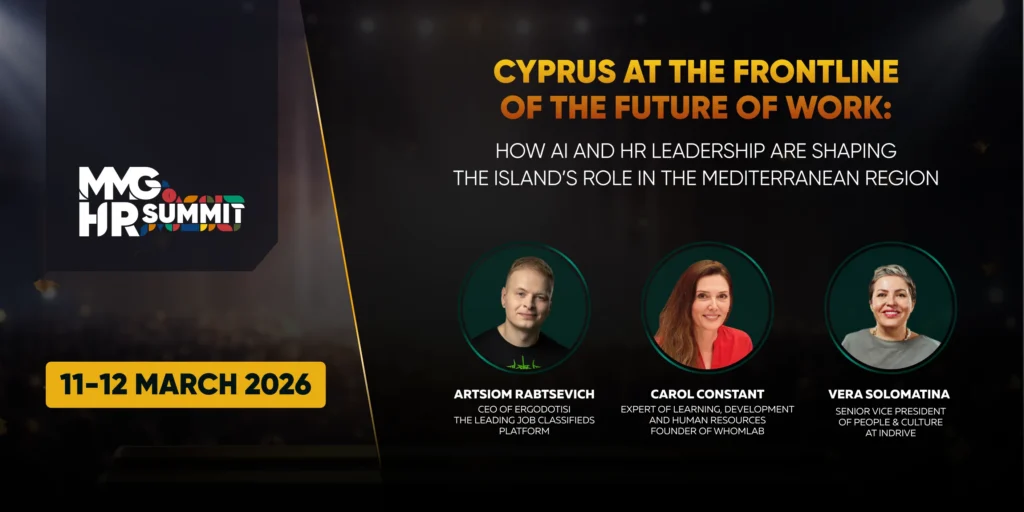
Cyprus at the Frontline of the Future of Work
Cyprus is not merely a tax-efficient jurisdiction or tourist destination, but also a strategic business location connecting Europe, the Middle East and North Africa. With hundreds of international companies operating regional headquarters, tech centres and financial operations from the island, the next competitive frontier is no longer corporate structuring — it is talent, culture and leadership.
At the centre of this shift stands a new generation of HR leadership. As global businesses recalibrate in response to AI acceleration, geopolitical shifts and workforce expectations, Cyprus finds itself at a pivotal moment: can a small but agile market set standards for the broader Mediterranean region?
This question forms the backbone of discussions at the upcoming MMG HR Summit Mediterranean in Limassol — a platform uniting HR leaders, founders and CEOs to explore the future of work through the lens of People, Culture and Global Connection.
Cyprus: From Business Platform to Talent Ecosystem
Over the past decade, Cyprus has evolved into a dense ecosystem of fintech, tech, shipping, professional services and investment firms. Many of these companies operate globally while managing multicultural teams locally. This creates a distinctive HR environment: English-speaking, cross-border, highly digital, but embedded in a relatively small labour market.
“Cyprus is no longer competing only on tax or infrastructure. It is competing on leadership quality and talent strategy. International companies here expect European HR standards, AI-enabled decision-making and strong cultural integration across diverse teams.”
Arsiom Rabtsevich, CEO, Ergodotisi
He notes that the island’s advantage lies in its agility. “In larger markets, transformation takes years. In Cyprus, we can pilot new workforce models, AI tools and hybrid policies faster — and scale them across regions.”
AI: From Automation to Strategic Intelligence
While artificial intelligence is often discussed in terms of job displacement, leading HR executives in Cyprus view it differently. The conversation has moved beyond CV screening and chatbots. Today 93% of Fortune 500 CHROs have already started integrating AI technologies and related tools to enhance their processes.
“The real transformation is not automation. It is intelligence. AI allows HR to move from reactive problem-solving to predictive leadership. We can anticipate burnout risks, identify skill gaps before they become critical, and model workforce scenarios aligned with business growth.”
Carol Constant, Founder, WhomLab
However, Carol stresses that AI adoption requires maturity. “Technology without governance creates risk. The challenge for HR leaders in Cyprus is to combine AI tools with ethical frameworks, GDPR compliance and transparent communication with employees.”
The Cultural Factor: Leadership in a Multinational Environment
Cyprus’ workforce is uniquely multicultural. In many international firms, more than half of employees are expatriates. This creates opportunities — and complexity. Leadership models must reconcile different communication styles, hierarchical expectations, and approaches to feedback and well-being.
“Cross-cultural leadership is not a soft skill anymore. It is a commercial necessity. If teams do not trust each other across borders, productivity drops. HR in Cyprus has to act as an architect of alignment — aligning global standards with local realities.”
Vera Solomatina, SVP People & Culture, inDrive
She adds that inclusion and well-being are no longer optional benefits. “Burnout, hybrid fatigue and digital overload are real risks in high-growth sectors. The companies that succeed will be those that treat wellbeing as a leadership KPI, not an HR initiative.”
A Mediterranean Perspective
What makes Cyprus particularly relevant is its position as a bridge market. With strong ties to both EU institutions and neighbouring regions, the island can function as a laboratory for cross-regional HR practices. The Mediterranean region faces shared challenges: brain drain, digital transformation gaps, demographic shifts and the need to upskill workforces rapidly.
“If we get HR leadership right in Cyprus — integrating AI, inclusion and global standards — we create a model that can be exported to other Mediterranean markets. That is a powerful positioning.”
Arsiom Rabtsevich, CEO, Ergodotisi
The Competitive Imperative
Global competition for talent is intensifying. Remote work has dissolved geographic boundaries, meaning that Cyprus-based firms now compete directly with companies in Berlin, London or Dubai for the same digital professionals.
“The future of work will not be defined by location, but by leadership capability. Cyprus has the infrastructure and international density to lead — but only if HR becomes truly strategic and data-driven.”
Carol Constant, Founder, WhomLab
A Defining Moment
For Cyprus, the transformation of HR is not a peripheral discussion. It is central to the island’s ambition to remain a relevant, resilient and attractive international business destination. As AI reshapes industries and employees demand meaning, flexibility and transparency, the question is no longer whether change will happen — but who will lead it.
These questions — from AI-driven workforce strategy to cross-cultural leadership and measurable wellbeing — will be at the centre of the MMG HR Summit Mediterranean in Limassol, bringing together HR leaders, founders and CEOs from across the region.