
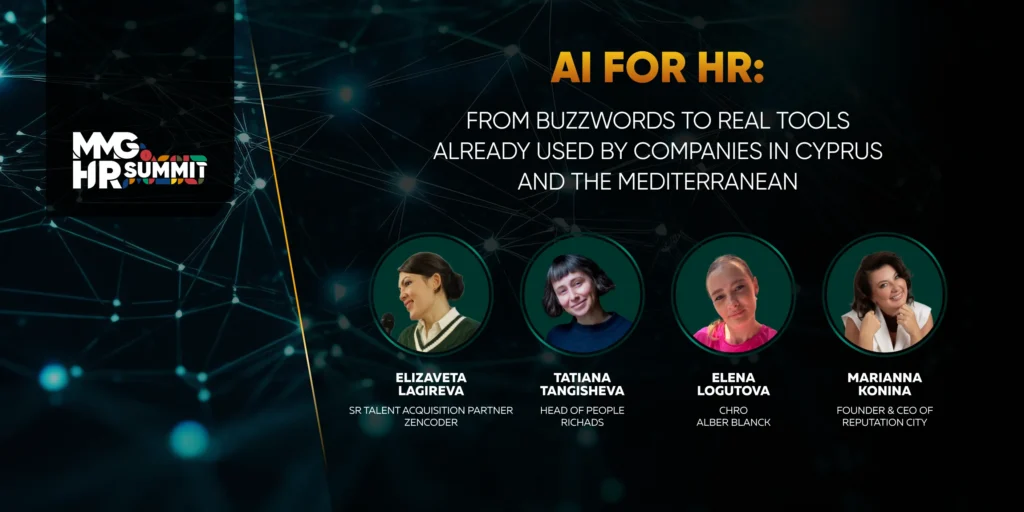
AI for HR: From Buzzwords to Real Tools Already Used by Companies in Cyprus and the Mediterranean
Is Artificial Intelligence in HR still a futuristic promise discussed only at global tech conferences? Or is it already in use in Cyprus and across the Mediterranean?
In preparation for the 2nd MMG HR Summit, taking place in Limassol on 11–12 March, we asked HR leaders and founders of leading regional businesses how they use AI in their daily work. The answer was clear: most are already integrating AI into recruitment, compliance, employer branding and workforce analytics. The conversation has shifted — from hype and experimentation to structured, practical implementation.
For years, AI in HR was mainly associated with automated CV screening and chatbots that answered candidate questions. Today, the focus is far more strategic. HR leaders are asking how AI can reduce hiring risks, strengthen employer credibility and support compliance in regulated industries such as fintech, igaming, investment services and tech — sectors that are particularly active in Cyprus. Continuously more, AI is reshaping decision-making itself.
A Diversified Ecosystem of Tools
AI in HR is no longer limited to automated CV screening or basic chatbots. Today, it represents a diverse ecosystem of platforms that support virtually every stage of the employee lifecycle. From organisational design aligned with business strategy to recruitment, onboarding, engagement, performance management, and learning, AI tools are embedded across functions.
“AI has significantly reduced our administrative workload. What used to take days — screening CVs, preparing documentation, analysing engagement data — can now be done in hours. But the real value is not just efficiency. It’s better decision-making based on patterns we couldn’t previously see.”
Elizaveta Lagireva, Sr Talent Acquisition Partner, Zencoder
In recruitment, platforms such as Eightfold AI, HireVue, SeekOut and Findem match candidates based on skills and predictive analytics rather than keywords alone. Tools like Textio optimise job descriptions for inclusivity and engagement. In employee experience and support, conversational AI systems such as Leena AI and Moveworks handle routine HR queries 24/7, while platforms like Lattice and Culture Amp analyse engagement data and sentiment.
In learning and development, systems such as Degreed and Cornerstone AI personalise training pathways and identify skills gaps. HR operations are increasingly automated through platforms like Workday Illuminate, HiBob and UiPath, while productivity tools such as ChatGPT Enterprise and Microsoft Copilot assist with documentation, communication and policy drafting.
Optimising Time and Cost
According to McKinsey’s 2023 report on generative AI, HR functions could automate between 30–40% of administrative tasks, significantly reducing time spent on repetitive processes. Deloitte’s Global Human Capital Trends research 2025 highlights that organisations using AI-driven talent analytics report faster hiring cycles and more accurate workforce planning.
For companies in Cyprus operating in competitive sectors such as fintech, tech and investment services, these time and cost efficiencies translate directly into agility — the ability to scale teams quickly and respond to market changes without proportionally increasing HR headcount.
The Limitations and Risks
Yet the rise of AI in HR raises concerns. Automated resume filters may overlook strong candidates who do not use the “right” keywords, reinforcing algorithmic bias rather than eliminating it. The forthcoming EU AI Act specifically addresses employment-related AI systems as “high-risk,” requiring transparency, documentation and human oversight.
“AI can filter thousands of profiles in milliseconds with exceptional analytical quality. At the same time, we cannot fully rely on its understanding of ambition, resilience, or cultural fit. Working with AI as a partner, each doing their part, is the key to success.”
Tatiana Tangisheva, Head of People, RichAds
Workforce Analytics: From Reporting to Strategy
Perhaps the most powerful promise of AI lies in workforce analytics. Predictive models can forecast turnover risks, identify skills shortages and simulate future workforce scenarios aligned with business growth. However, even with advanced analytical capabilities, AI is not prepared to replace human strategic thinking.
“Workforce analytics gives us powerful dashboards and predictive insights. But strategy is not built on dashboards alone. It requires understanding people, market context and long-term vision. AI informs strategy — it does not create it.”
Elena Logutova, CHRO, Alber Blanck
Reputational Visibility in AI-Driven Ecosystems
As generative AI tools mediate how candidates research employers, companies must recognize that their culture, leadership credibility, and workplace practices are now interpreted not only by people but by algorithms.
“AI models are becoming a new layer of reputation infrastructure. Candidates and partners are increasingly trusting AI-generated answers when evaluating a company’s credibility. Reputation management today must include AI visibility as part of a comprehensive, strategic approach.”
Marianna Konina, Founder & CEO, Reputation City
Assistant or Manager?
The number of AI tools available to HR leaders today is growing. They automate workflows, reduce administrative routine, and provide analytical insights. Yet AI remains, fundamentally, an assistant rather than a manager. The real transformation occurs when AI frees HR leaders from repetitive tasks, allowing them to focus on strategy, cultural development, relationship-building and long-term organisational design.
In Cyprus and across the Mediterranean, the discussion has moved beyond whether AI should be used in HR — the real question is how to integrate technological capability with human judgment in a responsible and strategic way. This conversation will continue at the upcoming MMG HR Summit in Limassol.